
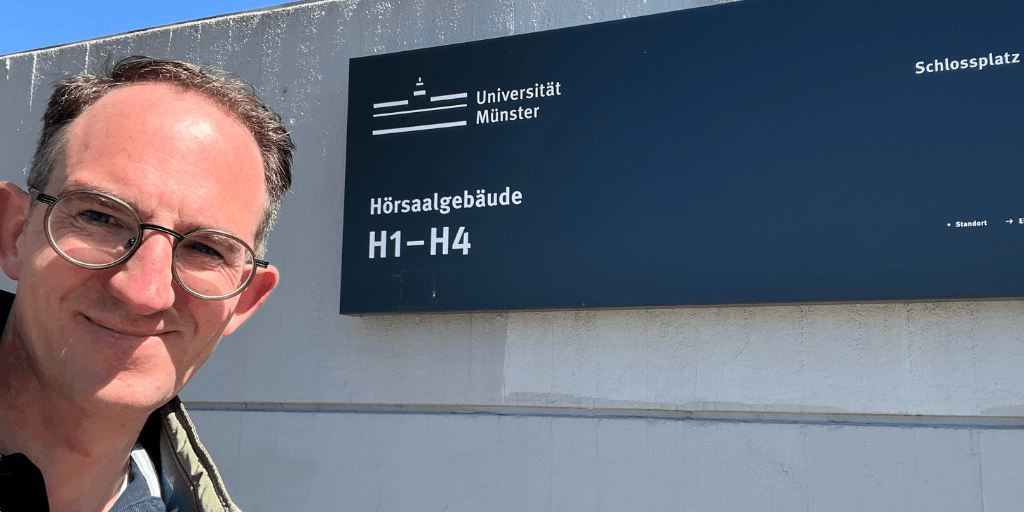
Last week I was a guest at the University of Münster.
As part of the Technology Management bachelor’s module, I had the opportunity to give a guest lecture on agile strategy work using OKRs at the Institute for Innovation, Strategy and Organisation – a setting that is not something I experience every day.
A lecture theatre instead of a workshop room.
Students instead of management.
And at the same time: surprisingly close to what I usually experience in companies on a daily basis.
A brief moment before the start
Before we set off, there was that moment you recognise from other situations:
How much prior knowledge do they have?
How practical should it be?
And how can we successfully bridge the gap – moving away from theory and towards real-world application?
What makes the university environment special
What surprised me in the room was how open the students were.
No “We’ve always done it this way” attitude.
No rigid ways of thinking.
In return, genuine interest, lots of questions and a desire to really understand things.
The topics are the same
And that’s when things got exciting.
After all, the questions were essentially the same as those asked in companies:
- How does strategy translate into concrete action?
- Who will take responsibility?
- How do you stay focused in everyday life?
The context is different.
The challenges are not.
The lecture was also covered by the Institute and summarised here.
A moment that stays with you
In the end, I asked a simple question:
What will you tell others about this event afterwards?
For me, the answers were almost the most valuable part:
practical, easy to understand and engaging – with a modern approach, interactive and offering a genuine change of perspective.
My personal conclusion
The talk reminded me once again that:
Strategy isn’t something for PowerPoint.
Nor is it purely a ‘management issue’.
It must be tangible. Comprehensible. Actionable.
Whether in the lecture theatre or in the workplace.
Why such formats are valuable
It is precisely these kinds of formats, outside the traditional corporate setting, that are of enormous help.
They force you to:
- Explaining things more clearly
- Questioning assumptions
- to reduce complexity
And that’s exactly what I’m taking away with me.
Many thanks to the team at the Institute for Innovation, Strategy and Organisation at the University of Münster for the invitation and the open discussion.

